From Technology to Trust
Accessibility becomes meaningful when trust leads the technology and the community shapes what gets built.
Occasional updates on Hearsee’s progress, delivered to your inbox. No spam, unsubscribe whenever you would like.
You can unsubscribe at any time using the link in any email we send.
Your input helps us build better tools for everyone in our community, whether it’s a quick thought or something more detailed.
Every submission goes to our team. We read all of them, though we can’t reply to each on indvidually.
Hear about news, pilots, product updates, and opportunities to get involved, sent a few times a month, never more.
You can unsubscribe at any time using the link in any email we send.
Tell us about your venue and timeline, and we’ll walk you through what a pilot involves, from mapping and installation to training and ongoing support.
Pilots typically begin within 4–6 weeks of signing on.
Tell us about your venue, and we’ll walk you through how Hearsee works: what installation looks like, what your visitors experience, and what independent navigation could look like in a space like yours.
We’ll get back to you within 2 business days.
This part of the community experience isn’t live yet. While we finish it, the best way to be part of the Hearsee story is to tell us yours.

St George, Utah
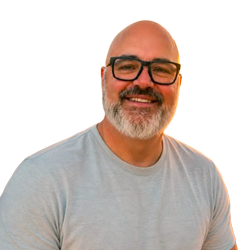
I’ve been deeply blessed with friendships in the blind community. The laughter, stories, and strength they share have shaped who I am. I’ve also seen how hard life can be when society doesn’t listen. Too often, we settle for the bare minimum and call it progress. That mix of joy and challenge is why I care so much about this work.
One of the most incredible things I’ve witnessed is how my blind friends keep moving forward. Every day, they navigate challenges that most of us never notice. Their resilience is an accomplishment worth celebrating.
It’s hard to watch how often accessibility gets treated like a checkbox. But when people take time to understand, their perspective changes—and they begin to see others in a new light. Blindness isn’t an absence of ability. My friends who are blind are bold, talented, and full of life. What holds them back isn’t their blindness; it’s not being made to feel welcome. As one of my friends once said, ‘People need community like fish need water.’ We can do better.
For my friends who are blind, independence means having the tools, access, and respect to live life on their own terms: walking into a building without barriers, making choices freely, and being recognized for their abilities, not their ‘limitations.’
Family brings me joy, and I find inspiration in using the talents I’ve been blessed with to help others. My advice to anyone who is sighted is simple: don’t assume, ask. Treat people who are blind with the same respect you’d want. Sometimes the best way to help is simply by being a friend, not a fixer.
Blindness doesn’t erase ability, it reveals it in new ways. Too often, we measure people by what they can’t see instead of what they can do. When we move beyond the bare minimum, we uncover creativity, strength, and talent that enrich everyone’s lives. To anyone reading this: you’re not alone. Whether you live with blindness, love someone who does, or are simply here to listen, your voice matters. Together, we can move from access to true inclusion.
Every voice here is real. Share Your Story

St George, Utah
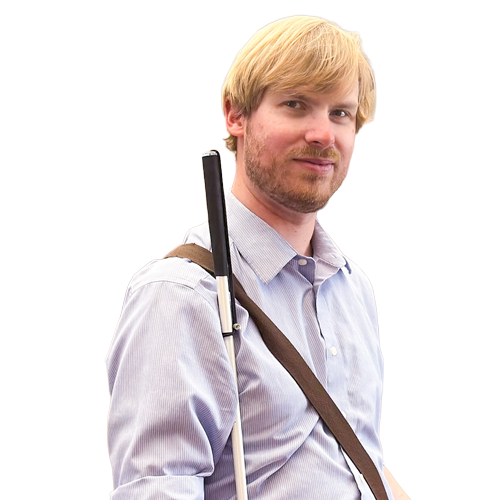
Tyson, 31, is a Senior at Utah Tech University studying Communications. He is the first of two siblings living with Retinitis Pigmentosa, a rare eye disease affecting how the retina interprets light. Tyson’s sight began to degrade in the third grade when he remembers wearing thick glasses to aid his vision and needing multi-volume large-print textbooks for classes. Though he can distinguish shapes and people of high contrast with the help of corrective glasses, Tyson broke so many pairs that he decided to stop wearing them, choosing to rely on his little remaining vision and a walking cane when in public.
Tyson trained at the Utah Division of Services for the Blind and Low Vision at the age of 18 to learn how to rely on his other senses to travel, clean, cook, and other life skills. He is considered a master at mental mapping, a skill in which someone can memorize their surroundings using specific environmental triggers, and has relied on these skills to confidently travel and live in multiple states.
He relied on environmental sounds to help him when traveling outside but admits this system is not without flaws. “Yesterday there was new construction on my path to school and it interfered with my environmental sounds. I couldn’t tell if I was going left or right or straight ahead, and accidentally veered into traffic! I didn’t realize it until a guy yelled at me from his car!”
Tyson continues to love dinosaurs, movies, collaborative games, and Star Wars. When asked how he would use Hearsee’s environment description service Tyson quickly replied, “The dinosaur museum! I grew up liking dinosaurs. A lot of museum displays show a descriptive video or audio, but they don’t actually describe the skeletons or displays. Sometimes it’s nice to be with someone who can describe the surroundings to you, but it would be great to appreciate the displays when I’m alone.”
Every voice here is real. Share Your Story

Salt Lake City, Utah
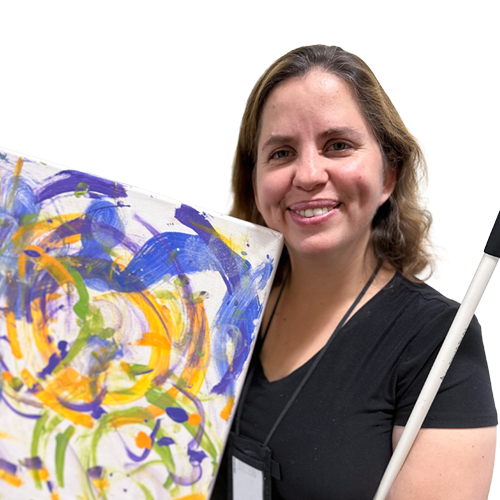
Danielle, 42, lost her sight at the age of 21. She has a love for life that has never diminished. When asked about her positive attitude, Danielle says, “You have to feel your path. I believe in people before anyone else does. A lot of sighted people think being blind is hard, but it’s all about how you look at life. There’s nothing I can’t do!”
Danielle’s positive attitude is perfectly suited to teaching. She is a Life Skills Instructor with the Utah Division of Services for the Blind and Low Vision (DSBVI), uplifting those transitioning into a life without sight by teaching them how to travel with a walking cane, how to cook and clean without sight, and how to enjoy the world around them as much as possible.
When asked where she would like to have an indoor navigation system installed for easier access to the blind Danielle said, “I want this stuff in all public bathrooms and to label trash cans! You know what’s embarrassing? Asking someone to help you find and flush the toilet!”
Danielle has found a passion for painting and sculpting since losing her sight. She credits a love of art and music for bringing her to her husband, saying she would paint while he played the guitar. She currently lives in Salt Lake City with her husband and daughter.
Every voice here is real. Share Your Story

Hurricane, Utah
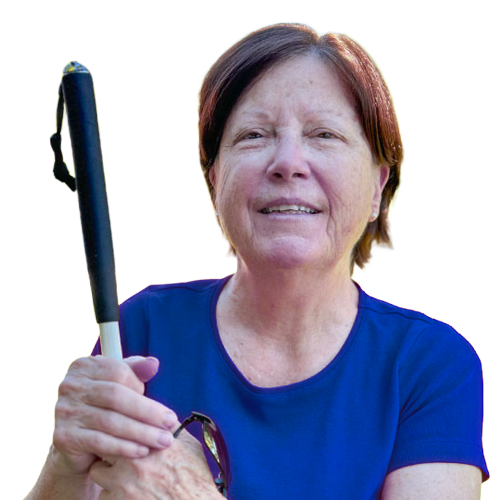
Cynthia, 60, lost her sight at the age of 55 due to Macular Degeneration, a condition that gradually degrades one’s central vision. Cynthia was determined to live as fully as possible and devoted 6 months to learning how to travel with a walking cane and adapt her daily life to her new condition with the help of trained life skill instructors, also blind.
Cynthia continues to garden and spend time outdoors as she did before losing her sight. She admits that her condition has caused her to reconsider how she enjoys these activities and that she’s proud of finding systems that work for her new lifestyle: “I love to garden. I love to get my hands in the dirt. I mark the different plants in my garden with chopsticks and different lengths of string. I can go out and pick all my produce and cook it myself. I love that none of our fresh food has chemicals.”
She says, “I’m just like you. I just can’t see. I can do everything I always did, except drive and catch baseballs.”
When asked if she’s comfortable walking around new places alone Cynthia laughingly admitted, “When I go somewhere new I walk towards any voices I hear. I just stand around listening to people to try and figure out where I should go. Lots of people assume someone blind is also deaf, so I get to be a fly on the wall! Isn’t that terrible?”
Every voice here is real. Share Your Story
Whether you’re interested in a one-time gift, ongoing giving, or a partnership between organizations, tell us a bit about what you have in mind and we’ll follow up.
Prefer to make a gift right now? Visit our Donate Page
Tell us where you’d want Hearsee next, like a school, library, or community space, and it goes on our list for future mapping.
We can’t promise a timeline yet, but every request helps us prioritize where to go next.